


GEM’s Battery Dismantling Volume Jumps 39% as Process Upgrades Drive Cost Reductions Across the Recycling Chain
On August 28, GEM Co., Ltd. (002340.SZ) released its interim report for the first half of 2026. Two figures from its battery recycling operations stand out.
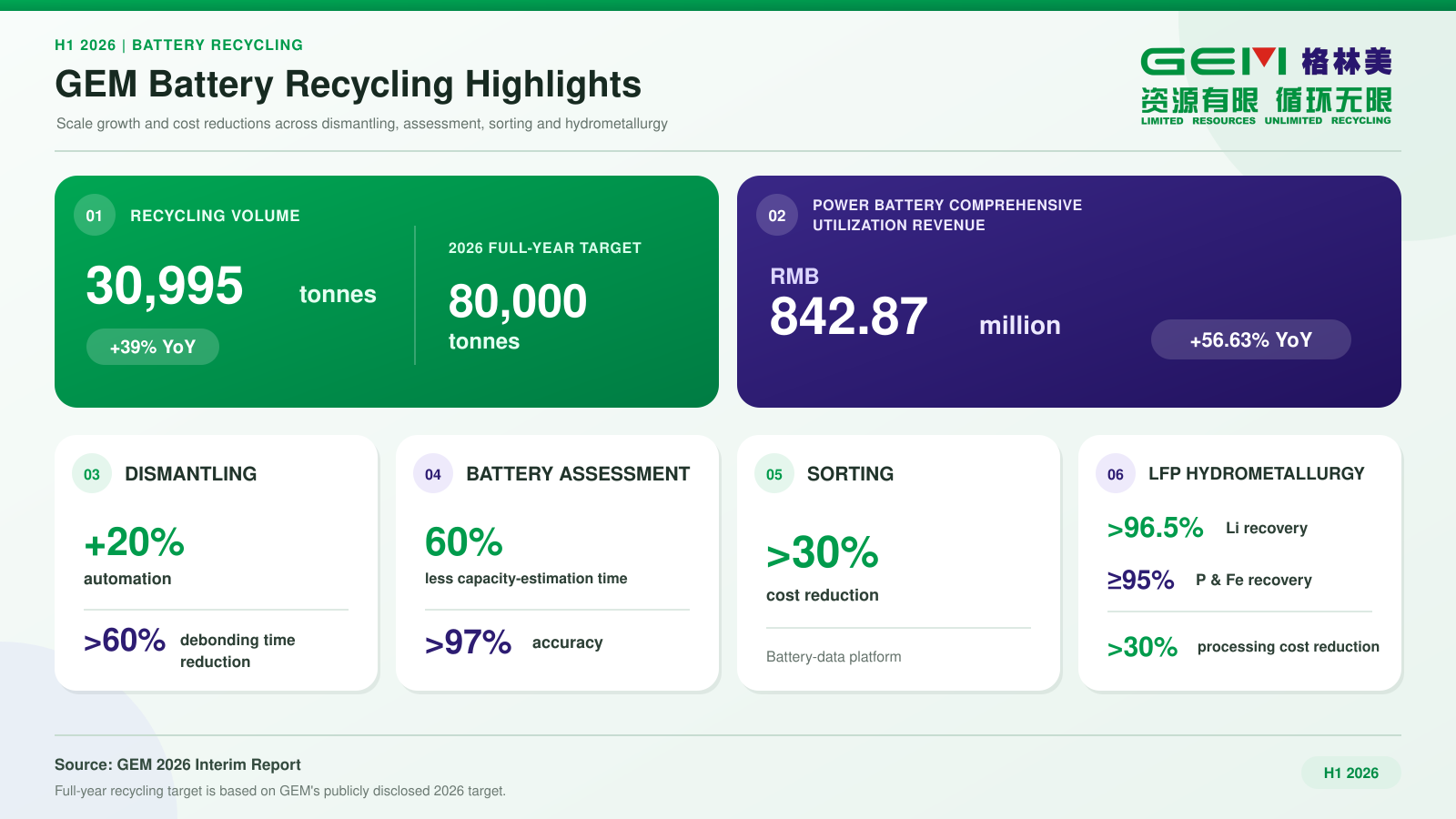
During the reporting period, GEM collected and dismantled 30,995 tonnes of retired power batteries, up 39% year on year. Revenue from the recycling and comprehensive utilization of power batteries reached RMB 842.87 million, an increase of 56.63%.
For the first time since 2023, revenue growth in this business exceeded the growth in dismantling volume. At the same time, GEM reported three technological developments targeting dismantling, battery assessment and sorting, and LFP hydrometallurgy.
The combination suggests that GEM is preparing not only for higher recycling volumes, but also for the next stage of competition: reducing the cost of processing each tonne of retired batteries.
Dismantling volume nearly doubled between 2023 and 2025
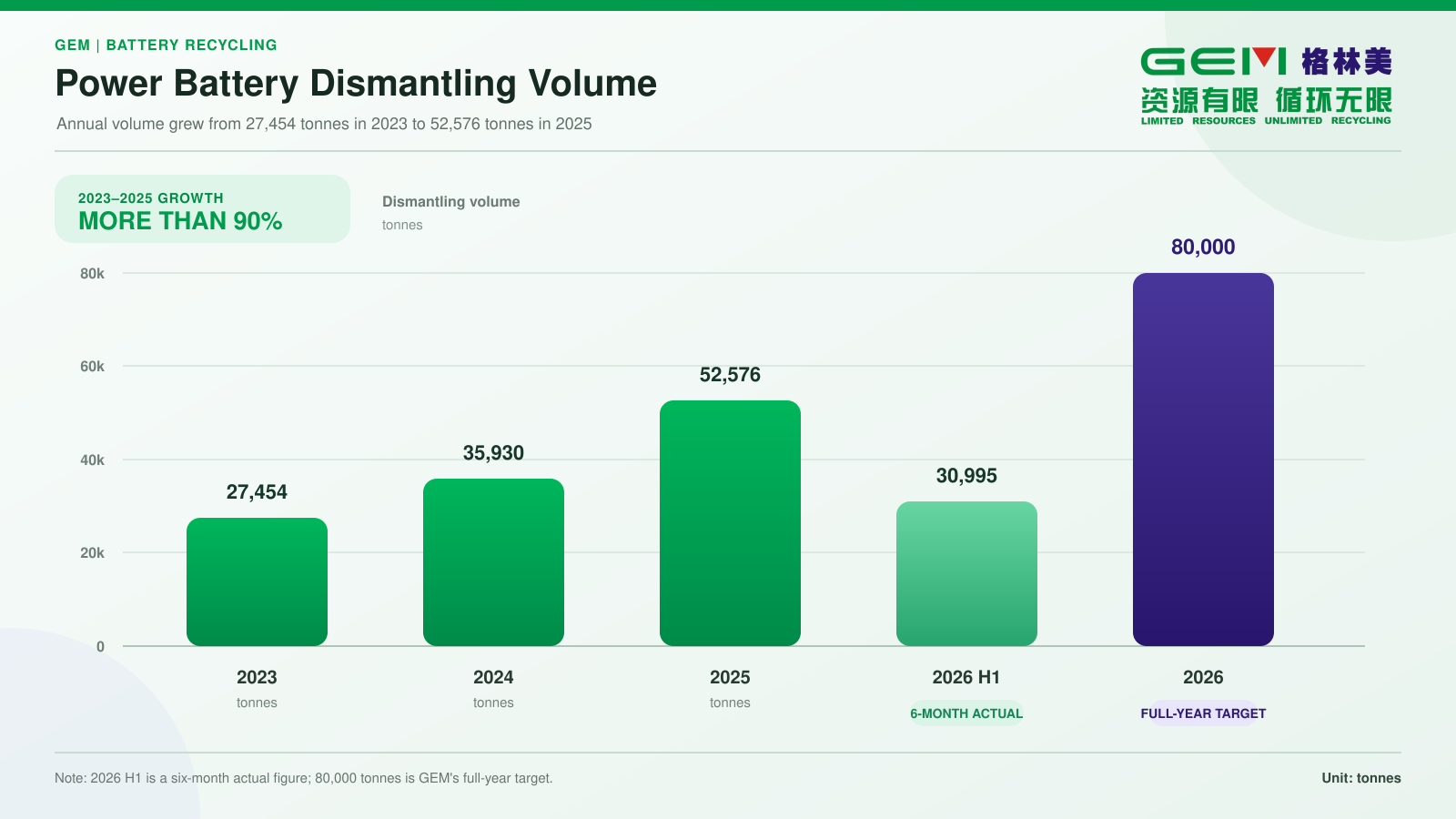
GEM’s annual power battery dismantling volume increased from 27,454 tonnes in 2023 to 52,576 tonnes in 2025, representing growth of more than 90% over the period.
According to the interim report, GEM has established partnerships with more than 1,100 automakers and battery manufacturers worldwide. Its partners include BYD, CATL, EVE Energy, Toyota, GAC Group and Zoomlion, with some cooperation structured around closed-loop recycling of lithium, nickel and cobalt.
The company operates six power battery recycling plants in China, covering the Pearl River Delta, Yangtze River Delta, Beijing-Tianjin-Hebei region and Central China. It has also established battery recycling joint ventures in South Korea and Indonesia.
GEM states that it currently handles approximately 10% of China’s retired lithium-ion batteries.
In the first half of 2026, the company’s dismantling volume reached 30,995 tonnes, up 39% year on year. GEM said the business remained profitable, while the proportion of batteries entering material recycling routes increased substantially.
Recovered lithium, nickel and cobalt are supplied to GEM’s own battery-material manufacturing operations, reinforcing its internal loop of:
Battery dismantling → metal refining → battery-material production
This internal integration gives GEM an outlet for recovered materials and strengthens its control over key raw-material supply.
Can GEM reach its 80,000-tonne target?
GEM has set a target of recycling 80,000 tonnes of power batteries in 2026, according to company information published by the Hubei Provincial Department of Ecology and Environment. Having processed 30,995 tonnes in the first half, GEM would need to complete approximately 49,000 tonnes in the second half of the year to reach its target.
That would require second-half volume to be nearly 60% higher than first-half volume. The target is ambitious, but GEM’s collection network, partnerships with automakers and battery manufacturers, and six-plant domestic recycling footprint provide a relatively strong feedstock foundation.
Nevertheless, collection volume alone will not determine profitability. Feedstock prices, battery chemistry, residual state of charge, transportation costs, product yields and recovered-material prices will all affect the economic result.
Revenue has recovered, but margin expansion remains modest
The interim report provides an important qualification to the revenue growth.
For the power battery comprehensive utilization business:
-
Revenue increased by 56.63%;
-
Operating cost increased by 55.99%;
-
Gross margin reached 10.51%;
-
Gross margin increased by only 0.38 percentage points year on year.
Therefore, the faster revenue growth does not yet represent a substantial improvement in margin. Costs increased almost in line with revenue.
The technology developments disclosed in the report should therefore be viewed as measures intended to improve GEM’s future cost position. They do not necessarily mean that all the reported efficiency gains had already been fully reflected in first-half financial performance.
The report also lists total revenue for GEM’s broader power lithium battery recycling segment at RMB 942.39 million. This includes RMB 842.87 million from power battery comprehensive utilization and RMB 99.52 million from end-of-life vehicle utilization.
Three technology developments target three major cost centres
GEM disclosed three battery recycling innovations in its interim report. Each addresses a different part of the recycling chain.
1. Dismantling: adaptive milling and laser cutting for CTP and CTB battery packs
Cell-to-pack and cell-to-body designs improve battery integration at the vehicle level, but they can make end-of-life dismantling considerably more difficult.
Structural adhesives used in these packs increase processing time and make standardized robotic dismantling more challenging.
GEM reported that it has developed:
-
Adaptive milling equipment for removing bottom adhesive from retired battery packs;
-
Precision milling equipment for battery terminals;
-
Laser-cutting workstations;
-
An upgraded environmentally friendly debonding agent.
According to the company, these developments have:
-
Increased line automation by 20%;
-
Reduced debonding time by more than 60%;
-
Supported the construction of a thousand-tonne-scale pilot production line for debonding agents.
The thousand-tonne figure refers to the scale of the debonding-agent pilot line, not the battery processing capacity of the dismantling system.
Automated dismantling is becoming increasingly important as battery pack structures become more integrated and less standardized. The economic value of automation lies not only in reducing labour requirements, but also in improving safety, throughput consistency and the recovery of undamaged components.
2. Battery assessment and sorting: a power battery data-processing platform
GEM has also developed and deployed a data-processing platform for retired power batteries.
The platform can automatically process test data, extract battery characteristics and predict remaining capacity. It can estimate remaining capacity using data from different voltage intervals rather than relying exclusively on a complete charge-discharge test.
GEM reports that the platform has achieved:
-
A 60% reduction in capacity estimation time;
-
Accuracy of more than 97%;
-
A reduction in battery sorting costs of more than 30%.
Battery assessment determines whether a retired battery should be repaired, repurposed, dismantled for component recovery or sent directly for material recycling.
Faster capacity estimation can reduce testing time and inventory turnover, while greater accuracy improves the allocation of batteries between second-life and material-recycling routes.
This also has a commercial impact. Reliable state-of-health and remaining-capacity data provide a stronger technical basis for valuing retired batteries and negotiating feedstock prices.
3. Hydrometallurgy: simultaneous recovery of lithium, phosphorus and iron from LFP batteries
GEM’s third development focuses on lithium iron phosphate batteries.
The company reported a process combining the simultaneous leaching and extraction of lithium, phosphorus and iron with staged impurity removal.
Reported performance includes:
-
Lithium recovery of more than 96.5%;
-
Phosphorus and iron recovery of at least 95%;
-
A reduction in processing costs of more than 30%;
-
Mass production of multiple high-purity lithium salts.
LFP recycling has historically faced more difficult economics than NMC recycling because LFP batteries contain no nickel or cobalt. Their recycling value depends more heavily on efficient lithium recovery, low chemical and energy consumption, and the successful utilization of phosphorus, iron, graphite and other lower-value materials.
Among the three technology developments, the LFP process is the only one for which GEM directly disclosed an overall processing cost reduction of more than 30%.
That makes it particularly relevant as the proportion of LFP batteries in China’s future retirement stream continues to increase.
Why the LFP process matters
As LFP becomes more prevalent in electric vehicles and energy storage, recyclers will increasingly need to process feedstock with lower intrinsic metal value.
Under an NMC-focused business model, nickel and cobalt can provide a significant part of the recovered-material value. With LFP, economics depend more heavily on:
-
Lithium yield;
-
Reagent consumption;
-
Energy use;
-
Wastewater and residue treatment;
-
Recovery of phosphorus and iron;
-
Graphite utilization;
-
Feedstock acquisition cost;
-
Stable outlets for recovered products.
A 30% reduction in LFP processing costs, if achieved consistently at commercial scale, could materially improve the economics of this chemistry.
However, the interim report does not disclose the original cost base, current cost per tonne, production scale of the new process or the proportion of GEM’s LFP feedstock already processed using the technology. Its commercial impact will therefore need to be evaluated through future operating data.
After the race for volume comes the race for cost
GEM expects China to enter a major vehicle and power battery retirement cycle from 2027. According to the interim report, approximately 3.5 million tonnes of retired lithium power batteries could require recycling between 2027 and 2030.
As feedstock volumes increase, the competitive focus is likely to shift gradually from securing batteries to controlling the cost and value recovered from each tonne.
The three figures disclosed in GEM’s report point in that direction:
-
Dismantling automation increased by 20%;
-
Sorting costs decreased by more than 30%;
-
LFP hydrometallurgical processing costs decreased by more than 30%.
Together, these developments address three different sources of cost.
Dismantling technology targets labour, safety and processing time. Data-driven sorting targets testing efficiency, inventory turnover and battery valuation. Hydrometallurgical innovation targets metal yield, reagent consumption and the economics of lower-value LFP feedstock.
GEM’s strategy is also supported by vertical integration. The company can channel recovered lithium, nickel and cobalt into its own refining and battery-material operations, rather than relying entirely on external buyers for intermediate recycling products.
This does not eliminate exposure to metal prices or competition for feedstock, but it can improve material circulation, product flexibility and raw-material security across the group.
Key figures at a glance
Conclusion
GEM’s first-half results show that its battery recycling business is expanding quickly: dismantling volume increased by 39%, while revenue grew by 56.63%.
But the more important signal may lie in the process developments behind those figures.
GEM is improving automation for highly integrated battery packs, using data to accelerate battery assessment and sorting, and targeting lower-cost recovery of lithium, phosphorus and iron from LFP batteries.
As China approaches a larger wave of battery retirements, recycling volume will determine which companies secure sufficient market presence. Their position on the processing cost curve—and their ability to generate value from increasingly diverse battery chemistries—will determine how competitive they remain.
Sources: GEM’s 2023-2025 annual reports; GEM’s 2026 interim report; Hubei Provincial Department of Ecology and Environment. Company performance and technology figures in this article are based primarily on GEM’s own disclosures.
